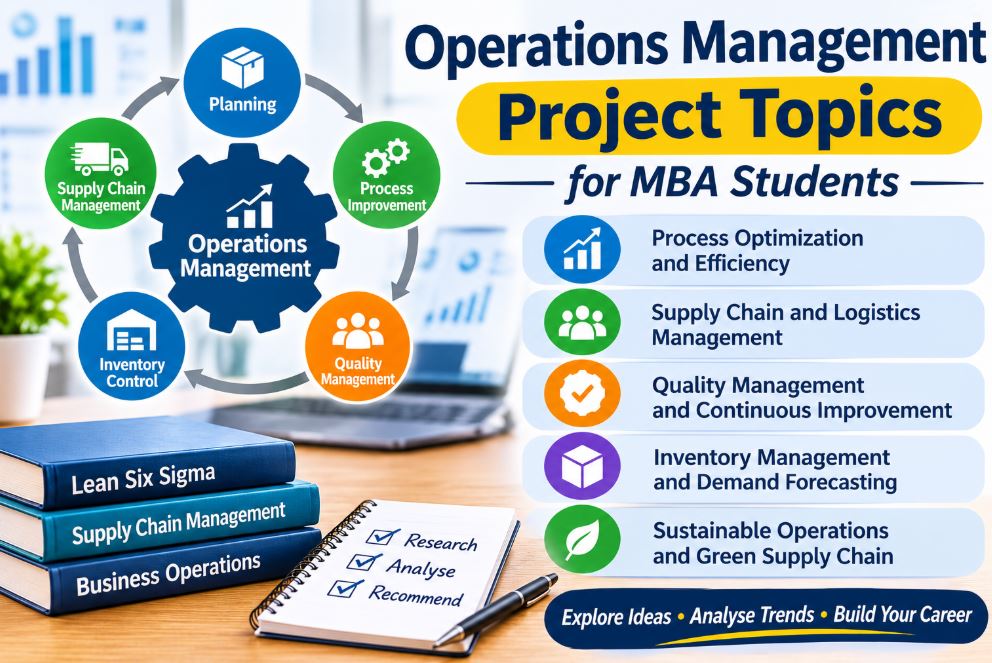
Operations Management Project Topics
A well-chosen operations project does more than fulfill a graduation requirement. Research with MBA students found that self-selected operations projects improved workplace performance, career development, project management experience, and course material learning. That is four career assets from one assignment.
The problem is not a shortage of topics. It is choosing a topic that is specific, data-accessible, and impressive to recruiters. This guide cuts through the noise with curated operations management project topics, a selection framework, and answers to the questions MBA students ask most often.
Why Operations Management Projects Matter for MBA Students
An operations project is a bridge between classroom theory and business reality. It forces you to do what managers do: define a problem, work with data, interact with stakeholders, and recommend a practical solution.
The benefits go beyond the grade.
- Career signal: A strong project shows recruiters how you think. It demonstrates analytical depth and practical relevance.
- Skill stack: You build capabilities in process improvement, analytics, procurement, logistics, and digital transformation.
- Portfolio proof: A completed project gives you a concrete story for interviews. You can talk about the problem, the method, and the result.
- Workplace impact: If the project is tied to your employer, the findings can improve real operations and raise your internal credibility.
Operations is no longer a back-office function. Modern operations integrate Lean Six Sigma with AI, IoT, digital twins, and sustainability. A project in this space signals that you understand where the function is heading, not just where it has been.
Who Should Choose an Operations Management Project?
This guide is written for MBA students in operations, supply chain management, general management, and business analytics. It also fits career switchers who want to move into operations, procurement, logistics, or process improvement.
You do not need a manufacturing background. Operations projects work in healthcare, retail, banking, food delivery, e-commerce, and public services. If you can identify a process, you can study it.
What Makes a Strong Operations Project Topic?
A strong topic is not the most sophisticated one. It is the most answerable one. The best projects share five traits:
- A clearly defined business problem
- A measurable objective
- Access to relevant data or information
- A realistic scope for the time available
- A recommendation the organization can actually use
Compare these two topics:
| Weak Topic | Strong Topic |
|---|---|
| “Study of Supply Chain Management in an FMCG Company” | “Identifying the Factors Behind Delivery Delays and Improving On-Time Delivery Performance” |
The first describes a subject. The second defines a problem with a measurable outcome. Recruiters and faculty both prefer the second.
Curated Operations Management Project Topics for MBA Students
The topics below are grouped by function. Each one can be narrowed to a specific company, industry, or process.
Supply Chain and Logistics
- AI-assisted demand forecasting for a retail chain: Compare a traditional forecasting model with a machine learning model and measure the improvement in forecast accuracy.
- Supplier evaluation and ranking system: Build a weighted scorecard for supplier performance and test it on a real vendor base.
- Supply chain risk assessment model: Map single-source dependencies and propose a diversification plan for a critical category.
- Bullwhip effect simulation: Use historical order data to quantify demand amplification and recommend information-sharing interventions.
- Last-mile delivery route optimization: Analyze delivery data to reduce cost per drop or improve on-time performance.
Inventory and Working Capital
- ABC and XYZ inventory classification: Segment a company’s SKUs by value and demand variability, then recommend stocking policies for each segment.
- Stock-out root cause analysis: Identify why high-demand products go out of stock and propose a replenishment fix.
- Slow-moving and obsolete inventory reduction: Quantify the working capital locked in dead stock and design a clearance or redeployment plan.
- Kanban-based replenishment design: Develop a pull-system proposal for a manufacturing or warehouse environment.
Quality and Process Improvement
- DMAIC project for defect reduction: Apply the Define, Measure, Analyze, Improve, Control cycle to a real production or service defect.
- Patient flow improvement in a hospital: Map the emergency or outpatient process and recommend changes to reduce waiting time.
- Procurement cycle time reduction: Identify approval bottlenecks and propose a simplified workflow.
- Service quality gap analysis: Use customer complaints and process data to locate the root causes of service failures.
Digital Operations and Industry 4.0
- AI in procurement: Evaluate how AI can improve the source-to-pay process, from intake to supplier selection.
- IoT-enabled inventory visibility: Propose a sensor or RFID pilot for real-time stock tracking.
- Digital twin for supply chain planning: Assess the feasibility of a digital twin for a specific planning decision, such as capacity allocation.
- Blockchain for supply chain transparency: Study a traceability use case and evaluate adoption barriers.
Sustainability and Lean Operations
- Green supply chain assessment: Measure the carbon footprint of a logistics network and recommend reduction levers.
- Lean waste audit in a service process: Identify the eight wastes in an administrative or healthcare process and quantify improvement potential.
- Circular economy in reverse logistics: Design a product return and recovery process for an e-commerce or electronics business.
How to Choose the Right Topic for Your Goals
Use this short framework before you commit.
Start with the decision, not the data. Ask: what decision does the business need to make? Then find the data that supports that decision. Starting with an available spreadsheet often produces a descriptive report with no recommendation.
Match the topic to your target role. If you want a supply chain role, choose a logistics or procurement topic. If you want consulting, choose a process improvement or diagnostic topic. If you want product operations, choose a digital or analytics topic.
Check access before you fall in love with the topic. A brilliant topic with no data is a dead end. Confirm that you can speak to process owners and obtain usable records.
Scope for the calendar, not for ambition. A narrow project completed well beats a broad project that never reaches a conclusion.
Common Mistakes to Avoid
- Choosing a topic because it sounds impressive rather than because it is answerable.
- Writing a descriptive “study of” report instead of solving a defined problem.
- Ignoring the cost of the recommendation. A good project includes a basic business case.
- Treating the project as an academic exercise. Recruiters want to see business relevance.
- Overcomplicating the methodology. A clear before-and-after comparison often beats an advanced model that no one understands.
Frequently Asked Questions
1. What is the best operations management project topic for an MBA student?
There is no single best topic. The best topic is one that connects to a real business problem, has accessible data, and aligns with your career target. A narrow process improvement project in a company you can access will usually outperform a broad theoretical topic.
2. Can I do an operations project without a manufacturing background?
Yes. Operations management applies to services, retail, healthcare, logistics, banking, and public sector processes. You can study patient scheduling, procurement cycles, delivery operations, or service quality without factory experience.
3. How long should an MBA operations project be?
Length matters less than depth and evidence. A focused 40 to 60 page report with clear data, analysis, and recommendations is stronger than a 100 page descriptive study. Follow your program’s guidelines first.
4. Should I choose a topic related to my current job?
If you have access, a workplace project is one of the strongest options. Research shows that self-selected workplace projects deliver benefits for performance, career development, and learning. You understand the process, you can get data, and the recommendation has a real chance of implementation.
5. What tools are useful for operations management projects?
It depends on the topic. Common tools include Excel, Power BI, Tableau, Python, R, and simulation software such as Arena. Lean Six Sigma projects use DMAIC and basic statistical process control. Do not choose a tool before you understand the problem.
6. How do I make my project stand out to recruiters?
Define a specific problem, show measurable before-and-after results, and include a practical recommendation with an implementation view. Recruiters value evidence that you can understand a business problem, work with data, and communicate findings.
7. Are AI and sustainability good topics for operations projects?
Yes, if they are grounded in a real operational decision. AI in demand forecasting, procurement automation, IoT inventory tracking, and green logistics are active areas with industry demand. Avoid writing a general essay on AI. Apply it to a process.
8. What is the difference between an operations project and a supply chain project?
Supply chain is a subset of operations. Operations management covers the broader set of processes that produce and deliver goods and services, including quality, inventory, process design, and capacity. A supply chain project focuses on the flow of materials, information, and money across organizational boundaries.
9. How do I measure the success of my operations project?
Success has two layers. Academic success is meeting your program’s rubric. Business success is delivering a recommendation that is specific, quantified, and feasible. A simple metric such as reduced cycle time, lower defect rate, improved forecast accuracy, or freed-up working capital gives your project credibility.
Conclusion
The right operations management project topic does more than check a box. It builds evidence of how you think, what you can analyze, and how you translate analysis into action. Start with a real problem, keep the scope tight, and choose a topic that connects to the role you want next. The topics in this guide are starting points.
Your best project will be the one you can support with data, stakeholder access, and a clear recommendation.

You may also like
International Business Project Topics for MBA Students in 2026