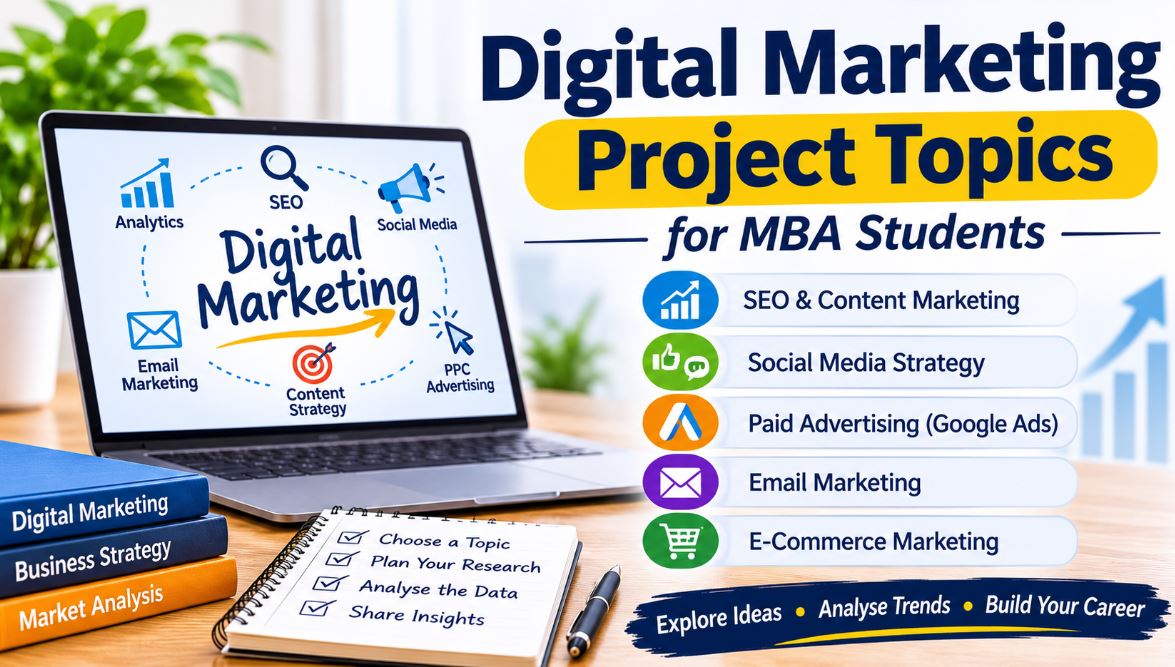
Digital Marketing Project Topics
Do you want to graduate with a degree that says you studied digital marketing, or do you want to walk into an interview with proof that you can actually do it?
That is the real question behind every MBA project you will ever pick. And nowhere is this more true than in digital marketing, a field that changes faster than most syllabi can keep up with. AI is rewriting search. Social algorithms are shifting under your feet. The tools you learn in semester one may feel outdated by semester four. A project is your chance to close that gap before you ever sit across from a hiring manager.
I have reviewed hundreds of MBA project reports. The ones that get remembered are not the ones with the fanciest covers. They are the ones where the student took a real problem, built a real strategy, and measured a real outcome.
This guide is built to help you do exactly that. No fluff. No recycled topic lists. Just the ideas, the logic, and the questions you need to pick a project that actually moves your career forward.
Why Digital Marketing Project Topics Matter More Than You Think
Here is the uncomfortable truth about most MBA marketing projects. They sit in a drawer.
A student picks a broad topic like “A Study of Consumer Behavior in E-Commerce,” writes 80 pages of secondary research, submits it, and never thinks about it again. The report checks a box. It does not build a skill.
A good digital marketing project does the opposite. It becomes a conversation starter in an interview. It becomes a portfolio piece you can pull up on your laptop and walk someone through. It becomes the difference between saying “I understand SEO” and saying “Here is an SEO audit I ran for a local business, the three issues I found, and the traffic lift we saw after fixing them.”
Employers today are not just hiring degrees. They are hiring proof. Digital marketing projects give you that proof when you do not yet have years of work experience to point to.
There is a second reason these projects matter. The field itself is moving too fast for theory alone. AI is now central to campaign planning, customer segmentation, content optimization, and performance monitoring. Answer engine optimization and AI-driven search are changing how brands get discovered.
A project forces you to sit with these shifts and figure out how they work in practice, not just how they are described in a textbook.
And a third reason: projects build judgment. You learn more from a small campaign that underperforms than from a chapter that explains why campaigns underperform. The failure teaches you. The data teaches you. The report becomes evidence of how you think.
Who Students Should Take These Projects Seriously
These topics are not just for the student who already knows they want a career in digital marketing.
They are for MBA students in marketing, business analytics, general management, and entrepreneurship tracks who want a portfolio that speaks a language employers understand. They are for the student who is tired of theoretical submissions and wants something that feels like work.
They are for final year students who need a capstone that connects classroom concepts to a real business problem. They are for students targeting placements at startups, D2C brands, agencies, or corporate marketing teams, where interviewers ask “show me what you have done” more often than “tell me what you studied”.
And they are for students who want options. A strong digital marketing project does not just open the door to a marketing job. It builds a foundation for freelancing, agency work, or even launching your own brand later. The skills transfer.
Digital Marketing Project Topics
Let me give you something more useful than a list of titles. Below is a categorized set of project topics with the tools and skills each one builds. Treat this as a starting point, not a script. The best project is the one you can connect to a real business, a real audience, or a real problem you care about.
| Category | Project Topic | What You Actually Do | Tools to Learn |
|---|---|---|---|
| SEO & Search | SEO Audit for a Local Business | Analyze page speed, title tags, meta descriptions, schema, and backlinks for a real local business. Deliver a prioritized fix list, not a generic report | Ahrefs, Google Search Console, Screaming Frog |
| SEO & Search | Comparative Analysis of SEO vs. SEM | Run a side-by-side analysis of organic and paid search for a niche. Compare cost per lead, traffic quality, and ROI | Google Ads, SEMrush, GA4 |
| AI & Automation | AI-Based Content Marketing Plan | Build a three-month content roadmap using AI tools for keyword research, outlines, and content positioning | ChatGPT, Semrush, Google Trends |
| AI & Automation | Answer Engine Optimization Case Study | Study how a brand appears (or disappears) in AI-generated recommendations. Propose an AEO strategy | AI platforms, search tools, analytics |
| Social & Content | Social Media Competitive Analysis | Track two competitors for two to three weeks. Analyze posting frequency, content types, and engagement patterns | Sprout Social, Meta Business Suite |
| Social & Content | Influencer Marketing ROI Study | Select ten real influencer campaigns in a niche. Evaluate cost, reach, engagement, and conversion signals | Hootsuite, analytics dashboards |
| Paid Media | Google Ads Campaign Simulation | Build a mock campaign with a fixed budget. Research keywords, write ads, define targeting, and project ROAS | Google Ads, Keyword Planner, GA4 |
| Analytics | Consumer Behavior Analysis with GA4 | Track and interpret user behavior on a live or demo website. Identify drop-off points and engagement gaps | GA4, Google Tag Manager, Looker Studio |
| Conversion | Conversion Rate Optimization Techniques | Run A/B tests or heuristic audits to improve sign-ups, inquiries, or purchases on a real page | Hotjar, Optimizely, GA4 |
| Brand & Reputation | Online Reputation Management Strategy | Monitor brand mentions, review sentiment, and search results. Build a response framework | Google Alerts, Buffer, review platforms |
Every strong topic has three things: a real subject (not a hypothetical), a measurable outcome (traffic, leads, engagement, conversion), and a tool stack you can actually learn. If a topic lacks any of these, it will struggle to become a portfolio piece.
Advantages:
Let me be specific about what a well-executed project gives you, because “it helps your career” is too vague to be useful.
A portfolio, not just a report. An SEO audit becomes a case study. A Google Ads simulation becomes a documented strategy with screenshots and notes. An influencer ROI study becomes a piece of analysis you can walk an interviewer through.
Tool fluency that employers can verify. You will not just know what GA4 is. You will have used it. You will have opinions about what it does well and where it falls short. That is the difference between a line on a resume and a conversation.
A story for interviews. When an interviewer asks about a time you solved a problem, you will have one. You will be able to talk about what you tried, what failed, what the data showed, and what you would do differently. That is rare. Most candidates cannot do it.
A clearer career signal. A project is a low-stakes way to test whether you actually enjoy SEO, or paid media, or analytics. You may discover you love the creative side of content and hate the spreadsheet side of performance marketing. Better to learn that during a project than during your first job.
How to Choose a Project Topics Without Overthinking
Here is a simple filter I would use if I were in your position.
Start with access. Do you know a small business owner? A startup founder? A friend with an Instagram shop? Choose a topic where you can get real data, even if the data is small. A messy real dataset beats a polished hypothetical one every time.
Pick one skill you want to be known for. If you want to be the analytics person, choose a GA4 or CRO project. If you want to be the content person, choose an AI content plan or a YouTube SEO strategy. The project is a signal. Make it a clear one.
Avoid the trap of “comprehensive.” A project that tries to cover SEO, social, email, and paid ads at once usually covers none of them well. Depth beats breadth in a portfolio. Go narrow enough to measure something meaningful.
Check the tool availability. Some of the best tools require paid subscriptions. Google Search Console, GA4, Google Trends, and ChatGPT’s free tier are enough to start. Do not let a tool paywall stop you from picking a strong topic.
FAQs About Digital Marketing Project Topics for MBA Students
1. What makes a digital marketing project “unique” enough for an MBA submission?
Uniqueness does not come from a never-before-seen topic. It comes from a specific context. The same SEO audit topic can be generic or unique depending on whether you are auditing a local dental clinic with a broken Google Business Profile or a D2C skincare brand losing organic traffic after a site migration. Specificity is what makes it yours.
2. Can I do a digital marketing project without a real client or business?
Yes, but you will get less out of it. Simulations and hypothetical brands are acceptable, especially for paid media or content planning. But if you can get even a small real business to share access to their analytics or search console, the project becomes far more credible and far more useful to you.
3. How technical does an MBA digital marketing project need to be?
It needs to be technical enough to be credible and strategic enough to be MBA-level. You do not need to write code. You do need to understand what the data means, why a metric moved, and what you would recommend. The analysis matters more than the tool.
4. Which project topic is best for placement interviews?
Topics that produce a tangible artifact tend to perform best. SEO audits, Google Ads simulations, and GA4 behavior analyses all give you something to show and discuss. Topics that are purely theoretical or based only on secondary research are harder to talk about in a practical interview.
5. How long should a digital marketing MBA project be?
Length is less important than depth and evidence. A focused 40 to 50 page report with real data, clear methodology, and actionable recommendations will outperform a 100 page report built on recycled secondary sources. Your evaluation should reward insight, not page count.
6. Can I combine two topics into one project?
You can, but be careful. Combining SEO and social media into one project often produces two shallow halves instead of one strong whole. If you must combine, connect them through a single business problem, such as “How a D2C brand can use content and search together to reduce customer acquisition cost.” The problem should be the anchor, not the channels.
7. What tools should I learn before starting?
At minimum, get comfortable with Google Analytics 4, Google Search Console, and one keyword research tool. If your project involves paid ads, add Google Ads or Meta Ads Manager. If it involves content, add ChatGPT and a basic design tool like Canva. You do not need every tool on day one. Learn what the project demands.
8. How do I avoid a project that feels outdated by the time I graduate?
Anchor your project in a durable problem, not a trending tactic. “How do we improve conversion rates on a product page” will always be relevant. “How to use the newest social media feature” may not be. Use current tools, but frame the project around a business outcome that will not expire in six months.
9. What is the biggest mistake students make with these projects?
Choosing a topic that sounds impressive but has no accessible data. If you cannot measure something, you cannot analyze it. If you cannot analyze it, the project becomes a summary of what other people have said. Pick a topic where you can get your hands on real numbers, even if the numbers are small.
A digital marketing project is not a box to tick before graduation. It is the earliest piece of professional evidence you will have. It tells an employer what kind of thinker you are, what kind of work you can do, and whether you understand how marketing actually functions outside a classroom.
You do not need a perfect topic. You need a real one, scoped tightly enough that you can measure something, learn something, and show something.
Pick the topic where you can get data. Build the version that produces an artifact. And write the report as if the person reading it is deciding whether to hire you.
Because in many ways, they are.

You may also like

International Business Project Topics for MBA Students in 2026