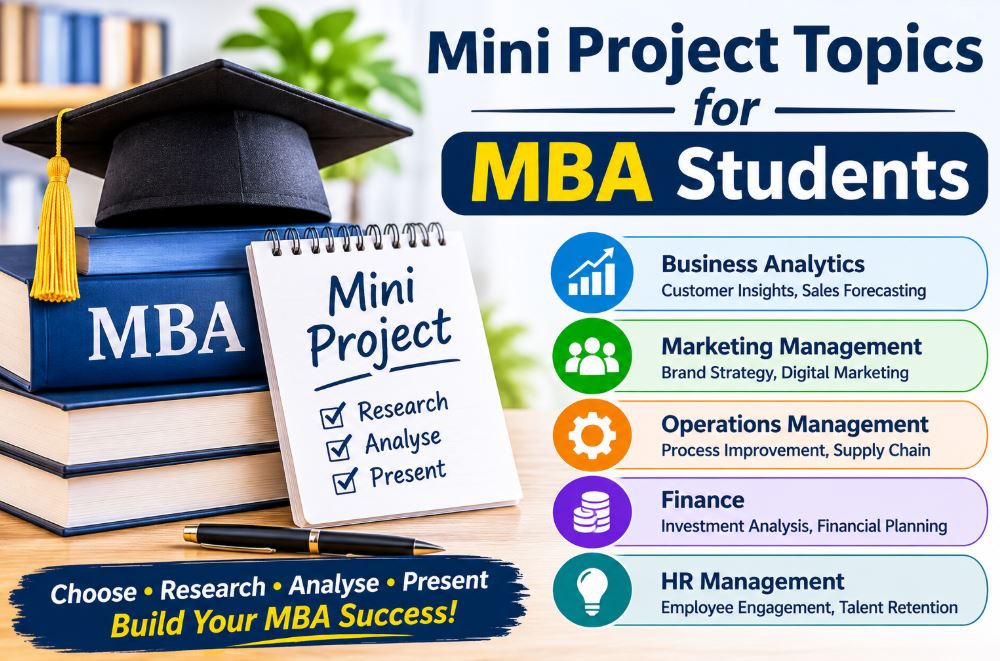
10 Ideal Mini Project Topics for MBA Students: A Practical Guide for 2026
An MBA without a hands-on project is like a pilot who has only read the manual but never sat in a cockpit. You can memorize every marketing framework, every financial model, and every supply chain theory. But until you apply them to a messy, real-world problem, the learning stays surface-level. That is exactly why mini projects exist.
A well-chosen mini project does more than tick an academic box. It forces you to collect data, talk to real stakeholders, make decisions with incomplete information, and defend your recommendations. It becomes proof that you can think like a manager, not just talk like a student.
In this guide, I break down 10 mini project topics that are relevant for 2026, explain why they matter, and show you how to pick the one that fits your goals.
What is a Mini Project?
The job market for MBA graduates has shifted. Recruiters no longer ask only about your GPA. They want evidence of problem-solving, data literacy, and the ability to work in ambiguous environments. Mini projects are the closest you can get to that evidence before your first full-time role.
Here is what a strong mini project actually builds:
- Practical judgment: You learn to apply theory to a situation that does not come with a clean answer key.
- Research and analytical skills: You practice gathering, cleaning, and interpreting data rather than just reading case studies.
- A portfolio asset: A completed project with measurable outcomes gives you something concrete to discuss in interviews.
- Industry exposure: You interact with real organizations, customers, or datasets, which sharpens your understanding of how business actually works.
- Confidence under pressure: You present findings, defend assumptions, and learn to iterate when your first approach fails.
In short, a mini project is not a formality. It is a compressed simulation of managerial work.
Who Should Take On a Mini Project?
Mini projects are not just for final-year students with a free semester. They are valuable for three groups:
- Students entering their final year who need a capstone-like experience before graduation.
- Students switching career tracks (for example, moving from marketing to analytics) who need demonstrable proof of new skills.
- Students targeting highly competitive roles in consulting, product management, fintech, or e-commerce, where a portfolio of applied work separates candidates quickly.
If you are early in your program and have no internship yet, a mini project can also serve as a substitute for work experience. It shows initiative and gives you something substantive to speak about.
10 Mini Project Topics That Deliver Real Value
Below are ten topics chosen for relevance, feasibility, and the depth of skills they build. Each one can be completed in a few weeks with accessible tools and data.
1. Generative AI Adoption in Marketing Teams
Generative AI is no longer a future trend. It is already inside content workflows, customer service, and campaign ideation. This project asks you to study how marketing teams actually use tools like ChatGPT, Jasper, or Midjourney, and where the gaps remain.
You can interview 5 to 7 marketing managers, map their adoption journey, and identify friction points. The output is a practical adoption roadmap that shows you understand both technology and organizational behavior.
Skills built: qualitative research, change management, AI literacy.
2. Quick Commerce Unit Economics for a Dark Store
Quick commerce is one of the fastest-growing retail models in urban India and beyond. Pick a dark store or a micro-fulfillment center and analyze its unit economics: cost per order, delivery batching efficiency, shrinkage, and contribution margin.
You can build a simple model in Excel and stress-test it under different demand scenarios. This project is ideal if you want to work in operations, retail, or startup finance.
Skills built: financial modeling, operations analysis, scenario planning.
3. ESG Scoring and Financial Performance in a Sector
ESG investing has moved from niche to mainstream, but the link between ESG scores and financial outcomes is still debated. Choose a sector (for example, IT services or FMCG), collect ESG scores and financial metrics for 15 to 20 companies, and run a comparative analysis. You do not need advanced statistics. A clean visual analysis with a clear narrative will do. This topic works well for finance and strategy students who want to show they can connect sustainability to business results.
Skills built: comparative financial analysis, sustainability literacy, data visualization.
4. Employee Retention in Hybrid Work Models
Hybrid work is here to stay, but retention remains a puzzle. This project surveys 30 to 50 employees across two or three organizations to understand what actually keeps people engaged in a hybrid setup: flexibility, manager support, career clarity, or peer connection. You can use Google Forms for data collection and Excel or SPSS for basic analysis. The findings will give you a nuanced view of modern HR challenges.
Skills built: survey design, HR analytics, evidence-based recommendations.
5. Influencer Marketing ROI for a D2C Brand
D2C brands spend heavily on influencers, but many cannot measure true ROI. Work with a small brand or simulate a campaign using publicly available data. Track engagement, conversion, and customer acquisition cost across nano, micro, and mid-tier influencers. Build a simple ROI dashboard in Power BI or Google Sheets. This project is perfect for marketing students who want to prove they can move beyond vanity metrics.
Skills built: marketing analytics, dashboarding, ROI thinking.
6. Vendor Risk Assessment for a Manufacturing SME
Supply chain disruptions have made vendor risk a board-level concern. Select a small or mid-sized manufacturer and assess its top 10 vendors on delivery reliability, financial health, geographic concentration, and compliance exposure. Create a scoring model and recommend a diversification strategy. This project gives you hands-on exposure to procurement and risk management without needing access to confidential data.
Skills built: risk modeling, procurement analysis, supply chain strategy.
7. Financial Literacy and Investment Behavior Among Young Professionals
This topic combines behavioral finance with primary research. Survey 50 to 100 young professionals about their saving habits, investment choices, and understanding of basic financial products. Then analyze the gaps between what they know and what they do. The output can be a short report with recommendations for fintech companies or financial educators. It is a strong choice for finance students interested in consumer behavior.
Skills built: survey research, behavioral analysis, financial communication.
8. Customer Churn Prediction for a Subscription Business
Subscription businesses live and die by retention. Use a publicly available churn dataset or partner with a small subscription company. Build a simple logistic regression model in Python or even Excel to identify the top three factors that predict churn. Present your findings as a retention playbook. This project signals to employers that you can connect data science to business action.
Skills built: predictive modeling, data cleaning, business translation.
9. Social Media Crisis Response Audit
Brands face crises in public, in real time. Choose two or three recent brand crises and audit how each organization responded on social media: response time, tone, channel choice, and outcome. Evaluate what worked and what backfired. This is a case-based project that sharpens your judgment about communication strategy under pressure.
Skills built: crisis communication analysis, social listening, strategic evaluation.
10. Working Capital Efficiency in a Small Business
Large-company finance is well documented. Small-business finance is where the real learning happens. Partner with a local SME and analyze its cash conversion cycle: days inventory outstanding, days sales outstanding, and days payables outstanding. Identify one or two practical levers to improve working capital. This project is grounded, useful, and immediately relevant to any finance role.
Skills built: financial statement analysis, cash flow management, SME consulting.
Quick Comparison Table
| Topic | Best For | Primary Tools | Core Skill |
|---|---|---|---|
| Generative AI in Marketing | Marketing, strategy | Interview guides, Excel | Qualitative research |
| Quick Commerce Unit Economics | Operations, startup finance | Excel | Financial modeling |
| ESG and Financial Performance | Finance, sustainability | Excel, Power BI | Comparative analysis |
| Hybrid Work Retention | HR, organizational behavior | Google Forms, SPSS | Survey analytics |
| Influencer Marketing ROI | Marketing, D2C | Power BI, Sheets | ROI measurement |
| Vendor Risk Assessment | Supply chain, operations | Excel | Risk scoring |
| Financial Literacy Study | Finance, fintech | Google Forms, Excel | Behavioral research |
| Churn Prediction | Analytics, product | Python or Excel | Predictive modeling |
| Social Media Crisis Audit | PR, brand management | Case databases | Strategic evaluation |
| SME Working Capital | Finance, consulting | Excel | Cash flow analysis |
How to Choose the Right Topic
Do not pick a topic because it sounds impressive. Pick one because you can finish it with the data and access you have. Three filters matter most:
- Data access: Can you get the numbers, interviews, or survey responses you need within two weeks?
- Skill alignment: Does the topic stretch one skill you already have and build one you want to develop?
- Career signal: Will this project give you a story that matters in an interview for the role you actually want?
If a topic fails any of these filters, move on. A completed, modest project beats an ambitious, unfinished one every single time.
Frequently Asked Questions
1. How long should an MBA mini project take?
Most mini projects run between three and six weeks. The scope should be narrow enough to complete alongside coursework. A focused 4-week project with a clear deliverable is better than a sprawling 3-month study that never ends.
2. Do I need advanced technical skills for these topics?
No. Most topics can be completed with Excel, Google Forms, and a basic dashboard tool. For the churn prediction topic, beginner-level Python is helpful but not mandatory. The goal is analytical thinking, not technical wizardry.
3. Can I do a mini project without a company partner?
Yes. Several topics in this list work with publicly available data, survey responses from your network, or simulated scenarios. What matters is that your methodology is sound and your conclusions are honest.
4. How is a mini project different from a final-year dissertation?
A mini project is shorter, narrower, and more applied. A dissertation typically involves deeper literature review and formal research methodology. The mini project is a sprint; the dissertation is a marathon.
5. Will a mini project actually help me get a job?
It can, if you present it correctly. In interviews, describe the problem, your approach, the data you used, and the recommendation you delivered. A concrete project story is far more persuasive than a list of courses.
6. Which topic is best for a student with no work experience?
The financial literacy study or the social media crisis audit are strong choices. Both rely on accessible data and do not require organizational access. They also demonstrate initiative and independent thinking.
7. Can two students collaborate on one mini project?
Many programs allow pair or small-group projects. Collaboration works best when the topic has clear, separable workstreams, such as data collection, analysis, and presentation. If you collaborate, define individual contributions upfront.
8. What makes a mini project report stand out?
A sharp problem statement, a transparent methodology, and recommendations that are specific and actionable. Avoid generic conclusions like “the company should improve marketing.” Say exactly what should change, for whom, and why.
9. Should I choose a topic related to my specialization or a broader business topic?
Start with your specialization. It gives you a head start on frameworks and vocabulary. If you are exploring a career switch, choose a topic in the target domain and use the project to build credibility.
The best mini project is not the one with the most impressive title. It is the one you actually finish, learn from, and can explain with clarity. Choose a topic that gives you access to real data, forces you to make decisions, and produces a deliverable you are proud to show. That is how a short academic exercise becomes a long-term career asset.

You may also like
International Business Project Topics for MBA Students in 2026
Digital Marketing Project Topics