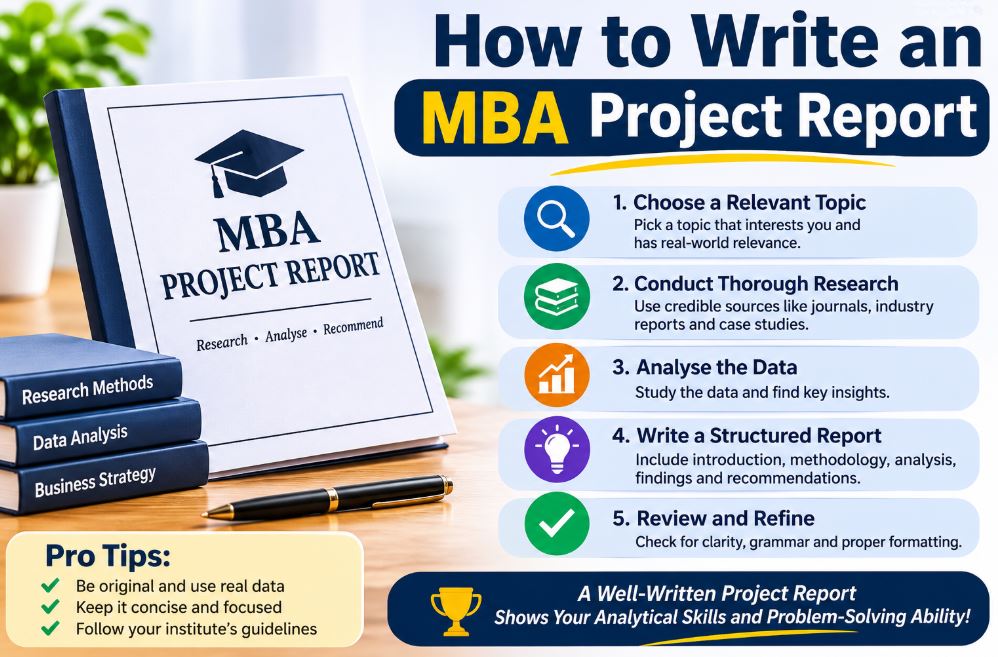
How to Write an MBA Project Report That Actually Gets You Noticed
Most MBA students treat the project report like a final hurdle. They rush through it, copy-paste a few chapters, and submit something that looks like a report but says nothing.That is a mistake.
An MBA project report is not just another academic assignment. It is the one piece of work in your entire program where you get to show a future employer how you think, how you analyse, and how you solve a real business problem. Done right, it becomes a career asset.
Done wrong, it becomes a bound copy that sits on a shelf and never gets opened again.
This guide breaks down exactly how to write an MBA project report that is structurally sound, academically credible, and genuinely useful to your career. No fluff. No generic advice. Just the framework that experienced project guides and examiners actually look for.
What Is an MBA Project Report, Really?
An MBA project report is a structured document that presents original research on a business or management problem. Unlike an engineering report that describes something you built, an MBA report describes research you conducted. The emphasis is on your literature review, your methodology, and your ability to interpret data into actionable recommendations.
It usually runs between 60 and 100 pages depending on your university, though some programs cap it at 60 pages of typed matter. The report is submitted in partial fulfilment of the MBA degree and is evaluated by both an internal guide and an external examiner.
What makes it different from a regular assignment is ownership. You choose the problem, you design the study, and you defend your findings in a viva. That is why the project report carries so much weight, both academically and professionally.
Importance of MBA Project Report
The project report is not a formality. It is a compressed version of the work you will do in a management role: identifying a problem, gathering evidence, making sense of messy data, and recommending a course of action.
Here is what the research and university guidelines consistently highlight about its importance.
It builds the skills employers actually test
The project report develops interviewing and report writing skills, but it also sharpens managerial and leadership capabilities, problem solving, and decision making. You are not just writing. You are managing a project with deadlines, stakeholders, and competing priorities.
It directly influences employability
A well-executed project can generate a prospective employer’s interest in your research and enhance your employability. Employers pay attention to the objectives, methodology, findings, and recommendations during recruitment. In a crowded job market, a project that solves a real problem for a real organisation is proof of ability, not just a claim on a resume.
It bridges the gap between theory and practice
The project is an opportunity to apply MBA concepts to a live business problem, demonstrating to future employers how you use what you have learned. That gap between classroom theory and workplace reality is exactly what hiring managers worry about. The project report is your chance to close it.
It can open doors before you graduate
A project conducted with a company can build a relationship with a prospective employer. The performance during the project may lead to a full-time job offer. Even if it does not, the final report becomes a portfolio piece you can discuss in interviews.
Who Should Take the MBA Project Report Seriously?
Technically, every MBA student who needs to graduate. Practically, the project report matters most for a few specific groups.
Final-year MBA students in their last semester. This is the most obvious group. The report is a degree requirement, and the viva is a gate you have to pass. But beyond compliance, this is your last structured opportunity to build a portfolio piece before you enter the job market full-time.
Students specialising in marketing, finance, HR, operations, or business analytics. The project is where your specialisation stops being a label on your degree and becomes evidence.
A finance student who builds a valuation model, an HR student who diagnoses retention drivers, or a marketing student who tests a positioning strategy all walk away with something concrete to show.
Distance and online MBA learners. If you are not on campus every day, the project report is your strongest signal that you can work independently, manage a long-term deliverable, and produce original analysis without constant supervision.
Students who want to move into consulting, strategy, or analytics. These roles test exactly what the project report demands: structured problem solving, data literacy, and the ability to turn findings into recommendations. A strong report is the closest thing to a work sample you can produce before you are hired.
Students who are still unsure about their career direction. The project gives you a low-stakes way to test a sector, a function, or a business problem before you commit to it. Choosing a topic aligned with your career aspirations is explicitly recommended in university guidelines because it contributes to your long-term goals, not just your grades.
The Core Structure of an MBA Project Report
Every university has its own template, but the chapter architecture is remarkably consistent. The table below shows the standard structure along with the rough weight each chapter carries in evaluation. Use it as a checklist, not a straitjacket.
| Section or Chapter | What Goes In It | Approximate Weight |
|---|---|---|
| Preliminary pages | Title page, declaration, certificate, acknowledgements, executive summary, table of contents, list of tables and figures | Not graded heavily, but missing pages cost marks |
| Chapter 1: Introduction | Problem statement, objectives, scope, significance, limitations, chapter organisation | Around 10 percent |
| Chapter 2: Literature Review | Critical analysis of 12 to 20 published sources, ending with the research gap | Around 25 percent |
| Chapter 3: Research Methodology | Research design, sampling, data collection, instruments, statistical tools, validity | Around 15 percent |
| Chapter 4: Data Analysis and Interpretation | Tables, charts, cross-tabulations, and written interpretation of what the data means | Around 35 percent |
| Chapter 5: Findings, Conclusions, and Recommendations | Summary of findings, conclusions tied to objectives, practical recommendations, scope for future research | Around 15 percent |
| References and appendices | Cited sources in a consistent style, questionnaires, interview guides, raw data if needed | Required but not separately weighted |
The weighting is not universal. Some universities distribute marks differently, and some include a presentation or viva component. But the pattern is clear: the literature review and data analysis chapters carry the most weight because they are where your research quality is most visible.
How to Write Each Chapter Without Losing Marks
Chapter 1: Introduction
This is not a warm-up. It is where you convince the examiner that your research is worth reading.
Start with a short company or industry background if your project is based on a specific organisation. Then state the problem in one or two clear paragraphs. Do not be vague. A common mistake is choosing a topic that sounds impressive but is too broad to research, such as “digital transformation in manufacturing” when you have no access to manufacturing decision-makers.
State four to six specific, measurable objectives as numbered points. Define what is inside your scope and what is outside it. Acknowledge your limitations honestly: sample size, geography, time period.
Examiners respect a student who knows the boundaries of their own study.
Chapter 2: Literature Review
This is where most MBA students lose marks. A literature review is not a list of summaries. It is a critical analysis of what has already been published, and it must end with a clear statement of the gap your research fills.
For each source you review, do three things: summarise what the researcher studied and found, evaluate the methodology and limitations, and explain how it connects to your own research. Do not just describe. Position each source in relation to your question.
End the chapter with a research gap paragraph. What specific question have previous researchers not answered that your study addresses? If you cannot answer that in two or three sentences, your literature review is not finished.
Chapter 3: Research Methodology
This chapter is where examiners check whether your findings can be trusted. Be specific.
Describe your research design (descriptive, exploratory, or causal). State whether you used primary data, secondary data, or both. Explain your sampling method and justify your sample size. For many MBA projects, a sample of 80 to 150 respondents is a reasonable range, but what matters more is that you justify your number rather than picking it arbitrarily.
Name your research instrument and your statistical tools. If you used SPSS, Excel, or any other software, say so. Address validity and reliability briefly but honestly. You do not need a doctoral-level defence, but you do need to show that you thought about whether your instrument measures what it claims to measure.
Chapter 4: Data Analysis and Interpretation
This is the heart of the report and carries the most evaluation weight. Do not dump tables and charts without explanation. Every table and every figure needs a clear title, a number, and three to four sentences of interpretation below it.
The key word is interpretation. What does each finding mean in the context of your objectives? Does the data confirm or contradict what the literature predicted? If a result surprises you, say so and explain why. Examiners are not just checking whether you can run a percentage analysis. They are checking whether you can think about what the numbers mean for a manager.
Chapter 5: Findings, Conclusions, and Recommendations
Summarise your most important results concisely. Then tie your conclusions back to each objective you stated in Chapter 1. If you set an objective, the reader should be able to find a corresponding conclusion.
Recommendations should be practical and specific. “The company should improve employee engagement” is not a recommendation. “The company should introduce a structured recognition programme for frontline staff, piloted in two branches over six months” is a recommendation. If your project is based on an organisation, write recommendations that someone in that organisation could actually act on. End with a short section on scope for future research.
Formatting and Submission Rules
Universities are strict about formatting, and small errors add up. The most common specifications include:
- Length: 60 to 100 pages of typed matter, depending on the university. Some programs cap the main body at 60 pages.
- Font and spacing: Times New Roman, 12 point, with 1.5 line spacing is the standard at many institutions.
- Margins: Typically 30 to 35 mm on the top, 25 to 30 mm on the bottom, 35 to 40 mm on the left, and 20 to 25 mm on the right for bound copies.
- Page numbering: Lower-case Roman numerals for preliminary pages, Arabic numerals from Chapter 1 onward.
- Plagiarism: Proper citation is non-negotiable. Paraphrased material must be acknowledged, and direct quotations must be placed in quotation marks with a full citation. Plagiarism checking software like Turnitin is widely used, and the consequences range from mark deductions to disciplinary action.
One more rule that students underestimate: submit a report that matches your approved synopsis. Submitting a report on a different topic or with a different scope than what was approved is one of the most common mistakes that reduces marks.
Seven Mistakes To Avoid In A Project Report
- Writing the full report before doing the research. The report is a record of research, not a substitute for it. Collect and analyse first, then write.
- Treating the literature review as a summary dump. Without critical analysis and a research gap, it reads like a book report, not an MBA chapter.
- Choosing a topic that is too broad or too disconnected from your access. Scope is the biggest cause of wasted time. Decide on two or three research questions early and let them guide what stays in and what stays out.
- Presenting data without interpretation. Tables and charts are evidence, not analysis. Tell the reader what the evidence means.
- Ignoring formatting guidelines. Wrong margins, missing page numbers, and inconsistent citations signal carelessness, even when the research is solid.
- Missing the submission deadline. Poor time management is explicitly listed among the mistakes that lower scores in MBA project evaluation.
- Being unprepared for the viva. The viva is not a formality. Examiners will ask why you chose the topic, what your objectives were, how you collected data, and what your key findings mean. If you cannot answer those questions without notes, your report is not finished.
FAQs About the MBA Project Report
1. How long should an MBA project report be?
Most universities require between 60 and 100 pages of typed matter, including chapters but sometimes excluding preliminary pages and appendices. Check your specific university guideline before you start writing, because the limit is often strict.
2. Can I use secondary data only for my MBA project?
Yes, many MBA projects rely on secondary data such as company reports, government data, and published research. But you still need a clear methodology chapter explaining how you selected and analysed that data. Primary data is not mandatory, but methodological clarity is.
3. What is the difference between an MBA project report and an engineering project report?
An engineering report describes something you built or implemented. An MBA report describes research you conducted on a business or management problem. In an MBA report, the literature review and methodology carry more weight than a build or implementation chapter.
4. How many references should I include in the literature review?
A common range is 12 to 20 published sources, including journal articles, books, and credible industry reports. Quality matters more than quantity. A critical review of 15 relevant sources is stronger than a list of 40 sources with no analysis.
5. Can I write my MBA project report on a company I do not work for?
Yes, many students write company-based projects without being employees. What matters is access to credible data and, where possible, a company certificate or permission letter. If you cannot get company-specific data, choose a sector-level or issue-based topic instead of forcing a company case study.
6. How do I avoid plagiarism in my project report?
Cite every source you paraphrase or quote, use quotation marks for direct text, and keep a reference list in a consistent style. Run your draft through a plagiarism checker before submission, and rewrite any section where your wording stays too close to the original source.
7. What questions are asked in an MBA project viva?
Examiners typically ask why you chose the topic, what your objectives were, which research methodology you used, how you collected data, what tools you used for analysis, what your key findings are, and what the limitations of your study are. Prepare short, direct answers for each.
8. Is it better to choose a topic I am interested in or a topic that is easy to research?
Choose a topic that sits at the intersection of your interest and your access to data. A topic you care about but cannot research will frustrate you. A topic that is easy to research but disconnected from your career goals will produce a forgettable report. The best topic is one you can defend in the viva and discuss in a job interview.
9. Can the MBA project report help me get a job?
Yes, if you treat it as a work sample. A project that solves a real problem, uses credible data, and produces actionable recommendations can generate employer interest and enhance your employability. Even the process of writing it develops the analytical and communication skills that hiring managers look for.
Conclusion
The MBA project report is not a box to tick. It is the one assignment in your program that follows you after graduation, in interviews, in conversations with employers, and in the way you approach problems for the rest of your career.
Write it like it matters. Because it does.

You may also like

International Business Project Topics for MBA Students in 2026