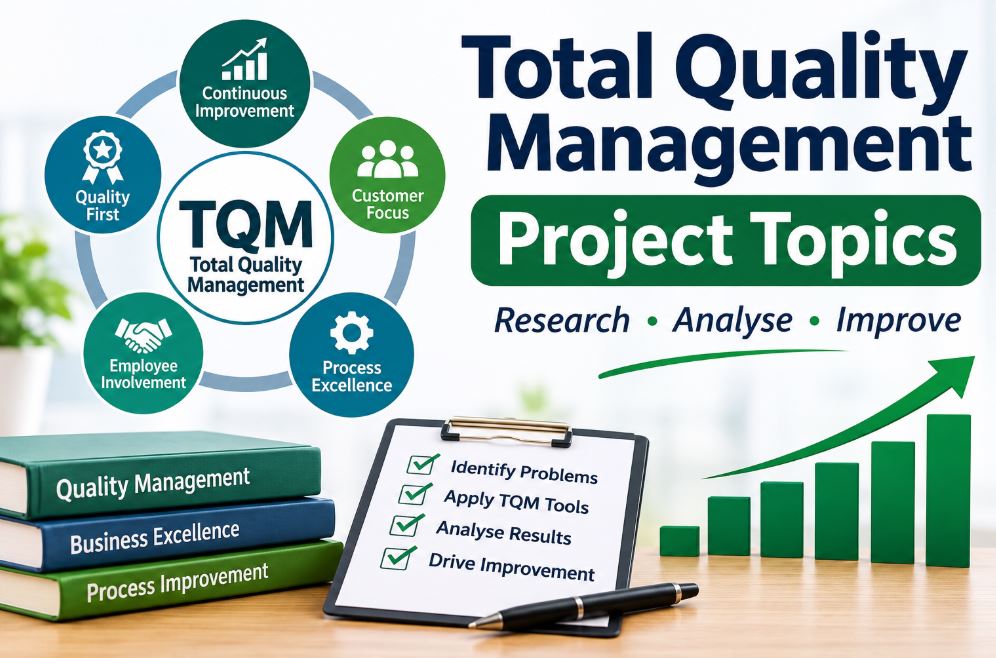
Total Quality Management Project Topics: 80 Real-World Ideas For Students
Here is the hard truth most students discover too late: a TQM project is not a theory assignment. It is a chance to walk into a real organization, find a real quality problem, and prove you can fix it using a structured approach. Done right, it becomes the strongest piece of work in your academic portfolio. Done wrong, it becomes another PDF that nobody reads.
This guide fixes that. You will get a clear explanation of what Total Quality Management actually is, why it matters more than ever in 2026, which students should take it seriously, and a vetted list of 80 project topics you can adapt immediately. No fluff. No recycled definitions. Just the information you need to pick a topic and start.
What Is Total Quality Management (TQM)?
Total Quality Management is a management philosophy built on one simple idea: quality is everyone’s responsibility, not just the quality department’s job. TQM integrates all functions and processes within an organization to achieve continuous improvement in the quality of goods and services delivered to customers.
The term took hold in the 1980s, but its roots go deeper. W. Edwards Deming, Joseph Juran, and Philip Crosby shaped the framework that modern organizations still use today. Deming’s chain reaction theory argued that higher quality leads to lower costs, better productivity, and stronger competitive position. Juran contributed the quality trilogy of planning, control, and improvement. Crosby pushed the idea of zero defects.
TQM breaks into three words that carry specific weight:
- Total means every person in every business area is involved.
- Quality means aligning all activities with the requirements of internal and external customers.
- Management means top leadership owns the responsibility for systematic quality development and assurance.
It is not a checklist. It is a way of organizing the whole to achieve excellence.
Why TQM Matters More Than Ever in 2026
The global market punishes organizations that treat quality as an afterthought. But the conversation around TQM has shifted. Recent research confirms that TQM remains a relevant management approach for improving organizational performance and supporting long-term competitiveness.
A 2026 study of 504 manufacturing firms found that TQM has a strong relationship with performance and simultaneously fosters organizational culture and innovation capability, both of which mediate the TQM-performance link. The same study revealed that digital readiness amplifies the capability-to-performance pathway, meaning TQM and digital transformation are no longer separate conversations.
The importance of TQM sits in four outcomes that every organization wants:
- Innovation. TQM encourages people at every level to question processes and suggest better ways of working. The 2026 evidence shows innovation capability is a direct mediator between TQM and performance.
- Adaptability. Organizations that build quality into their culture respond faster to change. Digital readiness strengthens this effect.
- Motivation. When people are trained and trusted to improve their own work, quality stops feeling like a mandate and starts feeling like ownership.
- Competitive edge. TQM integrates the business around a common purpose, giving the organization a distinctive advantage that competitors cannot copy overnight. Critical success factors include leadership, customer focus, human resource management, continuous improvement, process management, and supplier management.
The Deming chain reaction makes the financial case plainly: improve quality, costs fall because there is less rework and fewer delays, productivity rises, prices become more competitive, market share grows, and the business survives.
It costs far more to attract a new customer than to retain an existing one, and TQM protects the retention side of that equation.
For small and medium enterprises, the stakes are even higher. SMEs are the engine of most economies, but many struggle because of low product quality and rising competition. TQM gives them a structured path to compete without massive capital investment. That is exactly why TQM project topics work so well for students: the problems are real, the solutions are measurable, and the organizations are often willing to collaborate.
Which Students Should Choose a TQM Project?
TQM is not reserved for one department. It applies wherever processes, customers, and quality gaps exist.
Engineering students (Mechanical, Industrial, Civil, Production) benefit most from topics that connect directly to their technical training. Defect reduction, process capability, maintenance optimization, and statistical process control are natural fits. Civil engineering students can apply TQM to construction quality, safety, and rework reduction.
MBA and management students should focus on the strategic side: leadership commitment, employee involvement, customer satisfaction measurement, and the relationship between TQM practices and organizational performance. A TQM project is a strong substitute for a generic case study because it forces primary data collection and implementation thinking.
Healthcare management and public health students have an urgent opportunity. TQM in healthcare directly affects patient safety, service delivery, and resource efficiency. Topics around patient feedback systems, emergency preparedness, and supply chain quality are in demand.
IT and software engineering students can apply TQM principles to process quality, defect density, requirements traceability, and service desk performance.
The vocabulary shifts, but the logic is identical. With digital readiness now proven to amplify TQM’s performance effects, IT students are uniquely positioned to study the intersection of quality and technology.
Education and social science students should not ignore TQM. Student-centric quality frameworks, faculty satisfaction, and institutional competitiveness are legitimate research areas with measurable outcomes.
The common thread is simple: if your discipline has processes, customers, and a gap between expected and actual quality, you have a TQM project.
80 Total Quality Management Project Topics
The topics below are grouped by domain, with one topic per row. Adapt the wording to your institution’s format, but keep the scope realistic. A good TQM project is narrow enough to finish in one semester and specific enough to produce measurable results.
Manufacturing and Production
| # | Project Topic |
|---|---|
| 1 | Reducing defect rates in an automotive component assembly line using TQM tools |
| 2 | Applying Pareto analysis and cause-and-effect diagrams to scrap reduction in a metal fabrication unit |
| 3 | Process capability study of a critical machining operation in an SME |
| 4 | Impact of 5S implementation on productivity and quality in a small manufacturing firm |
| 5 | TQM-based maintenance plan improvement for cost reduction in a plating area |
| 6 | Reducing rework in an electronics assembly process through statistical process control |
| 7 | Quality function deployment for a new product launch in an FMCG company |
| 8 | TQM implementation in materials management to reduce rejection rates |
| 9 | Effect of total productive maintenance on overall equipment effectiveness in a fishmeal factory |
| 10 | Cost of quality analysis in a textile manufacturing company |
Service Industry and Hospitality
| # | Project Topic |
|---|---|
| 11 | Customer satisfaction measurement in a hotel using TQM dimensions |
| 12 | Service quality gap analysis in a restaurant chain |
| 13 | Applying TQM to reduce waiting time in a retail banking branch |
| 14 | Employee involvement and service recovery performance in a call center |
| 15 | TQM practices and customer loyalty in the insurance sector |
| 16 | Process improvement in a logistics service provider using DMAIC |
| 17 | Service blueprinting and quality function deployment for a tourism operator |
| 18 | Impact of leadership commitment on service quality in a hospital front office |
| 19 | TQM in higher education administration: improving student enrollment processes |
| 20 | Reducing complaint resolution time in a telecommunications service center |
Healthcare and Patient Safety
| # | Project Topic |
|---|---|
| 21 | Role of TQM in enhancing patient safety in a secondary care hospital |
| 22 | Continuous improvement of emergency trolley inventory management using Lean TQM principles |
| 23 | Patient feedback integration into quality decision-making in a public hospital |
| 24 | TQM and healthcare service delivery in a government referral hospital |
| 25 | Reducing medication errors through process standardization and checklists |
| 26 | Leadership commitment and patient-centered care in a private clinic |
| 27 | TQM framework for medical supplies authority performance improvement |
| 28 | Data-driven quality evaluation of diagnostic laboratory services |
| 29 | Employee engagement and infection control compliance in a hospital ward |
| 30 | Applying FMEA to high-risk clinical procedures |
Construction and Civil Engineering
| # | Project Topic |
|---|---|
| 31 | Implementing TQM in a public infrastructure bridge project |
| 32 | PDCA-based quality control for structural strengthening of a commercial building |
| 33 | Reducing rework in road construction through TQM and critical path method integration |
| 34 | Safety and quality integration in construction site management using TQM principles |
| 35 | Material validation and tensile testing as quality control measures in bridge construction |
| 36 | TQM and building information modeling integration for defect reduction |
| 37 | Waste register and rework minimization in a residential construction project |
| 38 | Supplier quality management in a mid-sized construction firm |
| 39 | Time efficiency and quality trade-offs in construction projects under TQM |
| 40 | Occupational health and safety quality improvement in road works |
IT, Software, and Digital Services
| # | Project Topic |
|---|---|
| 41 | Quality management in a software development lifecycle using TQM principles |
| 42 | Process capability study in a business process outsourcing unit |
| 43 | Reducing defect leakage in software testing through root cause analysis |
| 44 | Service desk quality improvement using TQM and ITIL alignment |
| 45 | Customer satisfaction with digital banking services: a TQM perspective |
| 46 | Agile retrospectives as continuous improvement mechanisms in software teams |
| 47 | Quality function deployment for e-commerce platform feature prioritization |
| 48 | TQM practices and project delivery performance in an IT services firm |
| 49 | Data quality management in a healthcare information system |
| 50 | Employee training and software quality outcomes in a startup environment |
SMEs and Entrepreneurship
| # | Project Topic |
|---|---|
| 51 | Developing a TQM model for a small manufacturing unit |
| 52 | Barriers to TQM implementation in small enterprises: a case study |
| 53 | Cost reduction through a quality approach in a family-owned business |
| 54 | Customer satisfaction through TQM in a local retail chain |
| 55 | Employee empowerment and quality performance in a small workshop |
| 56 | TQM adoption and export competitiveness of SMEs |
| 57 | Quality culture assessment in an emerging SME |
| 58 | Supplier partnership practices in a small manufacturing firm |
| 59 | Process standardization in a food processing SME |
| 60 | Continuous improvement practices in a handicraft enterprise |
Education and Institutional Quality
| # | Project Topic |
|---|---|
| 61 | Student-centric TQM framework for improving learning outcomes |
| 62 | Impact of industry collaborations on educational quality |
| 63 | Faculty satisfaction and institutional quality culture |
| 64 | Reducing student service turnaround time using TQM tools |
| 65 | Continuous improvement of curriculum delivery through PDCA |
| 66 | TQM in examination process management |
| 67 | Student feedback systems as a driver of teaching quality |
| 68 | Institutional competitiveness and TQM adoption in higher education |
| 69 | Placement support quality improvement using DMAIC |
| 70 | Classroom discipline and student empowerment through quality management principles |
Tools, Techniques, and Cross-Cutting Themes
| # | Project Topic |
|---|---|
| 71 | Comparative study of Deming, Juran, and Crosby frameworks in modern organizations |
| 72 | Effectiveness of Six Sigma projects in manufacturing SMEs |
| 73 | FMEA application for risk reduction in a production process |
| 74 | Quality function deployment for service design improvement |
| 75 | Impact of ISO 9000 certification on TQM maturity |
| 76 | Total productive maintenance and quality performance: a correlation study |
| 77 | Employee training and TQM success: a quantitative analysis |
| 78 | Leadership styles and TQM implementation outcomes |
| 79 | Cost of poor quality analysis in a service organization |
| 80 | Sustainability and TQM integration in supply chain management |
That is 80 topics, and you can combine or narrow any of them. The best project is the one you can attach to a real organization, even a small one. A local workshop, a clinic, a college office, or a family business is enough. TQM does not require a Fortune 500 client. It requires a process and a willingness to measure it.
How to Choose the Right Topic
Three filters will save you weeks of confusion.
Filter 1: Access. Can you get permission to observe the process and collect data? A beautiful topic with no data access is a dead project. Start with organizations you already have a relationship with.
Filter 2: Measurability. Can you define a baseline and a post-intervention number? Defect rate, cycle time, complaint volume, scrap cost, patient wait time, rework percentage. If you cannot measure it, you cannot prove improvement.
Filter 3: Scope. Can you complete the diagnosis, intervention, and analysis within your academic timeline? A plant-wide TQM transformation is a five-year consulting engagement, not a semester project. Choose one process, one line, one department, or one service.
The strongest TQM projects follow a simple arc: define the quality problem, measure the current state, analyze root causes, implement a countermeasure, and report the result. That is the PDCA cycle in practice, and it is the backbone of almost every credible TQM report.
Frequently Asked Questions About TQM Project Topics
1. What is the difference between a TQM project and a Six Sigma project?
TQM is the broader management philosophy focused on continuous improvement, customer focus, and total employee involvement. Six Sigma is a specific methodology with a defined toolkit, such as DMAIC, aimed at reducing variation and defects. A TQM project can use Six Sigma tools, but it is not limited to them. Think of TQM as the culture and Six Sigma as one of the methods inside that culture.
2. Can I do a TQM project without an industry internship?
Yes, but you need access to a real process. Many students use their college canteen, library, administrative office, or a family business as the study site. The principle is the same: identify a quality gap, apply TQM tools, and measure the outcome. A well-executed campus-based project is far stronger than a theoretical industry project with fabricated data.
3. Which TQM tools are essential for a student project?
You do not need all of them. The core set is: Pareto chart, cause-and-effect diagram, check sheet, histogram, control chart, scatter diagram, and process flow chart. These are the seven basic quality tools. For service projects, add service blueprinting and gap analysis. For manufacturing projects, add process capability studies and FMEA.
4. How long should a TQM project report be?
Length matters less than structure. A typical undergraduate or MBA project report runs 40 to 80 pages including appendices. The core chapters are introduction, literature review, methodology, data analysis, findings, recommendations, and conclusion. Do not inflate the page count with copied theory. A tight 45-page report with real data beats a 120-page report with none.
5. What makes a TQM project “unique” for evaluation?
Originality comes from the context, not the tool. Applying a Pareto chart is not unique. Applying a Pareto chart to a specific process in a specific organization and finding a non-obvious root cause is unique. Focus on primary data, a real baseline, and a countermeasure that was actually implemented or simulated with verifiable assumptions.
6. Is ISO 9000 the same as TQM?
No. ISO 9000 is a set of international standards for a quality management system. TQM is a broader philosophy that includes customer focus, employee empowerment, continuous improvement, and leadership commitment. ISO certification can be a milestone within a TQM journey, but it is not the destination. ISO is technical and procedure-focused, while TQM is behavioral and culture-focused.
7. Which sector is easiest for a student TQM project?
Service sectors are often easier to access, but manufacturing offers cleaner numerical data. The “easiest” sector is the one where you already have a contact person and permission to observe. Do not choose a sector because it sounds impressive. Choose it because you can get in, collect data, and finish on time.
8. How do I measure customer satisfaction in a TQM project?
Use a structured instrument, not a single question. The SERVQUAL dimensions, Likert-scale surveys, and complaint categorization are common approaches. Define your customer group clearly: internal customers, external customers, or both. Report response rates and limitations honestly. A small sample with transparent limitations is more credible than a large sample with suspiciously perfect results.
9. What are the most common mistakes students make in TQM projects?
Three mistakes dominate. First, choosing a topic that is too broad, such as “TQM implementation in a company,” which becomes a descriptive report with no intervention. Second, skipping the baseline measurement, which makes it impossible to prove improvement. Third, treating TQM as a literature review exercise instead of an applied problem-solving exercise. Fix those three and your project will stand out.
Conclusion
A TQM project is not about memorizing Deming’s fourteen points or reproducing a textbook definition. It is about proving that you can see a quality problem, structure a response, and measure whether the response worked. That skill travels across every industry and every job function.
Pick one topic from the list. Narrow it until it fits your access and your timeline. Measure the baseline before you change anything. And write the report as if the organization will actually use it, because the best ones do.

You may also like

International Business Project Topics for MBA Students in 2026